<b>Intake behavior and nutrient digestion of beef cattle fed with grass silage</b> - DOI: 10.4025/actascianimsci.v31i4.5782
Keywords:
beef cattle, digestibility, intake, inoculant
Abstract
The main objective was to study the effect of dry matter content, the addition of bacterial inoculant and particle size reduction on Tanzania grass (Panicum maximum) silage on digestive parameters. Seven ruminally cannulated Nellore beef steers were randomly assigned to a 7 x 7 Latin Square design. Treatments were described as follows: T1: wet forage + small particle; T2: T1 + inoculant; T4: wilting + large particle; T3: T4 + inoculant; T6: wet forage + large particle; T5: T6 + inoculant; T7: T6 + ground pearl millet grain. The ruminal passage rate of solid (2.35% h-1) and liquid (3.17% h-1) phases were similar across treatments. The animal intake behavior was not significantly changed by treatments, averaging 293 (minutes d-1) and 68 (minutes DM kg-1) for time and rate of eating, respectively. For rumination and chewing, the mean values observed were 432 (minutes d-1), 102 (minutes DM kg-1) and 725 (minutes d-1), 170 (minutes DM kg-1), respectively. No significant differences were observed for the DM (61.40%), ADF (59.69%), CP (43.93%) and NDF (60.34%) digestibilities. The mean DM intake (1.1% BW) was not different among treatments. It was concluded that the strategies adopted during the ensiling of Tanzania grass did not result in significant changes on the parameters.Downloads
Download data is not yet available.
Published
2009-11-09
How to Cite
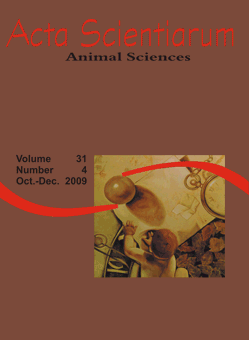
Paziani, S. de F., Nussio, L. G., Loures, D. R. S., Schmidt, P., Zopollatto, M., & Ribeiro, J. L. (2009). <b>Intake behavior and nutrient digestion of beef cattle fed with grass silage</b> - DOI: 10.4025/actascianimsci.v31i4.5782. Acta Scientiarum. Animal Sciences, 31(4), 373-380. https://doi.org/10.4025/actascianimsci.v31i4.5782
Issue
Section
Ruminant Nutrition
DECLARATION OF ORIGINALITY AND COPYRIGHTS
- I Declare that current article is original and has not been submitted for publication, in part or in whole, to any other national or international journal.
The copyrights belong exclusively to the authors. Published content is licensed under Creative Commons Attribution 4.0 (CC BY 4.0) guidelines, which allows sharing (copy and distribution of the material in any medium or format) and adaptation (remix, transform, and build upon the material) for any purpose, even commercially, under the terms of attribution.
Read this link for further information on how to use CC BY 4.0 properly.


0.9
2019CiteScore
29th percentile
Powered by