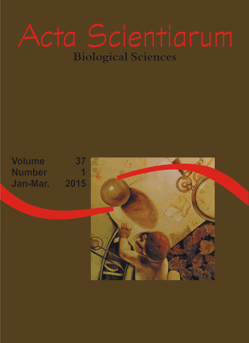
<b>Relationship between bacterial density and abiotic factors at different sediment depths of lakes in the Upper Paraná River floodplain
Resumo
River-floodplain systems are known for their heterogeneity of habitats and the hydrological pulse, the main driving force, which increases nutrient concentrations at the onset of the flood due to leaching from the littoral region and decomposition. This decaying organic matter tends to be deposited in the sediment, where occur biogeochemical processes associated with microorganisms. This study aimed to characterize the vertical distribution of bacterial density in the sediment strata of six environments of the Upper Paraná River floodplain, checking similarity as for bacterial density and physical and chemical conditions. To this end, we analyzed the following factors: total phosphorus, total Kjeldahl nitrogen, levels of organic and inorganic material, oxidation potential and particle size. The results evidenced a gradient of vertical distribution of bacterial density, with predominance of cocci, which possibly indicates no nutrient limitation in this limnic compartment. The analysis of variance was applied to determine significant differences between the layers of the sediment and environments. It can be observed a tendency of deposition of total-P and MI within the upper layers of all environments. More reducing potentials in the initial layers indicate a higher bacterial activity, since this region possesses a greater availability of most easily decomposable material.
Downloads
DECLARAÇÃO DE ORIGINALIDADE E DIREITOS AUTORAIS
Declaro que o presente artigo é original, não tendo sido submetido à publicação em qualquer outro periódico nacional ou internacional, quer seja em parte ou em sua totalidade.
Os direitos autorais pertencem exclusivamente aos autores. Os direitos de licenciamento utilizados pelo periódico é a licença Creative Commons Attribution 4.0 (CC BY 4.0): são permitidos o compartilhamento (cópia e distribuição do material em qualqer meio ou formato) e adaptação (remix, transformação e criação de material a partir do conteúdo assim licenciado para quaisquer fins, inclusive comerciais.
Recomenda-se a leitura desse link para maiores informações sobre o tema: fornecimento de créditos e referências de forma correta, entre outros detalhes cruciais para uso adequado do material licenciado.