
Informamos aos leitores, editores, autores e revisores que o Portal de Periódicos ficará indisponível de 04 a 24 de maio de 2026 para a realização do upgrade do OJS para a versão 3.4.
We inform readers, editors, authors, and reviewers that the Journal Portal will be unavailable from May 4 to May 24, 2026, due to the OJS upgrade to version 3.4

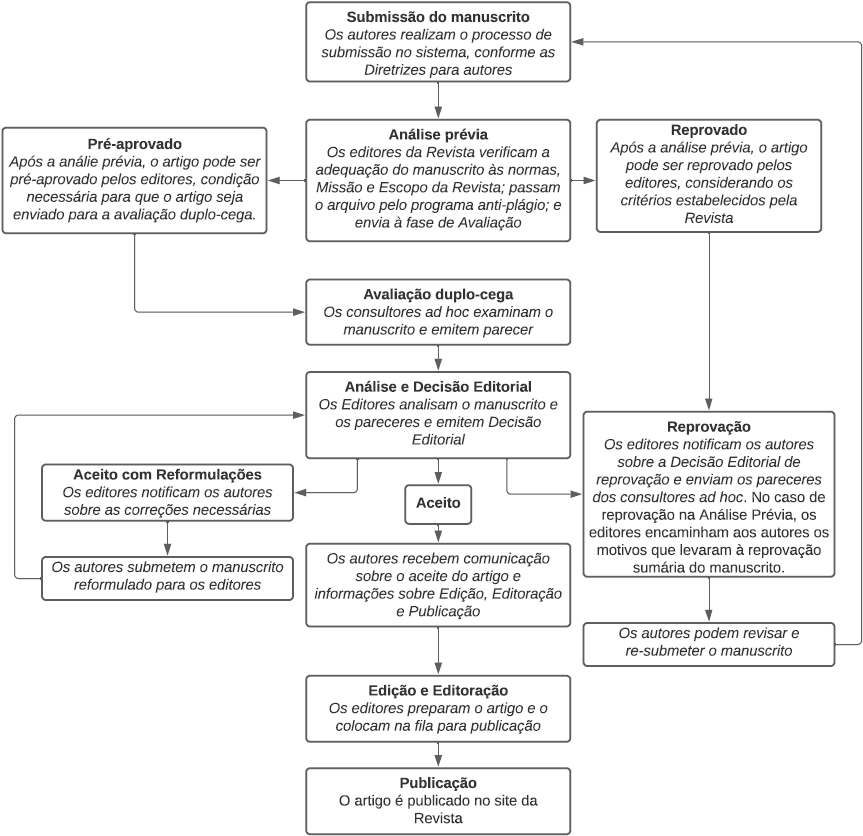
Após a verificação pela equipe editorial da adequação do manuscrito ao foco e ao escopo da Revista e do atendimento às normas informadas no site, os artigos são avaliados, aplicando-se o processo duplo-cego.
O processo de avaliação é idêntico para todos os artigos ― inclusive os previamente disponibilizados no SciELO Preprints.
Nos casos de preprint, os(as) pareceristas tomam conhecimento da autoria do manuscrito (simples-cego). Ao submeter um artigo depositado em repositórios de preprints, os(as) autores(as) concordam com esse formato de avaliação.
Os manuscritos são avaliados por dois pareceristas externos à Revista, de comprovada produção científica da área de conhecimento da pesquisa, de instituições de ensino e/ou pesquisa nacionais e estrangeiras, cuja seleção é realizada mediante palavras-chave do artigo. Ao indicar uma palavra-chave, o editor de seção escolhe dentre os consultores cadastrados dois com produção na área do artigo a ser avaliado.
Os consultores selecionados recebem a solicitação de avaliação por e-mail no endereço eletrônico cadastrado no portal da Revista, com a informação sobre o prazo para indicar se aceita realizar a avaliação e o prazo para a conclusão da avaliação. No caso de o consultor selecionado informar que não está disponível para a avaliação, outro consultor da área é selecionado. Ao se aproximar o prazo para a realização da avaliação, o consultor recebe um e-mail automático com lembrete de avaliação; se não realizar a avaliação no prazo, ele será substituído.
O manuscrito que recebe um parecer favorável e um desfavorável à sua publicação é encaminhado a um terceiro parecerista, também anônimo e externo à Revista. Os autores podem acompanhar o processo de avaliação das suas submissões no OJS, utilizando login e senha para o acesso, sendo possível o acesso aos pareceres.
Aos pareceristas são disponibilizadas as diretrizes a serem seguidas, que incluem os seguintes aspectos: originalidade do artigo; pertinência da discussão, dos dados informados, da interpretação, da metodologia e das referências citadas; clareza e adequação do título, do resumo, das palavras-chave, da introdução, do desenvolvimento e da conclusão.
O aceite do artigo pode ser total ou condicionado a reformulações e a correções propostas pelos avaliadores e pelos editores. No caso de o artigo obter aprovação condicionada a reformulações e/ou alterações, estas deverão ser realizadas pelos autores no prazo definido pela equipe editorial e de acordo com as orientações enviadas juntamente com os pareceres.
Os autores devem indicar no manuscrito todas as alterações realizadas e justificar, caso alguma alteração sugerida não tenha sido atendida. Modificações de estrutura e de conteúdo sugeridas no decorrer do processo de avaliação somente serão realizadas mediante a concordância dos autores.
Artigos não alterados conforme as recomendações dos pareceristas e da equipe editorial ou entregues fora do prazo estabelecido podem ser recusados pela equipe editorial.
Os artigos aprovados saem do status “Em avaliação” e passa para o status “Em edição”, fase de preparação do texto para a sua publicação. Durante esse processo, poderão ser solicitadas informações aos autores. Esse processo ocorre tanto nas avaliações de artigos submetidos em fluxo contínuo, como na avaliação de artigos submetidos a chamadas temáticas.
O aceite do manuscrito não garante a sua imediata publicação. Uma vez aprovado, sua publicação respeitará os critérios de data de submissão e de localização geográfica das instituições de afiliação dos autores. Com o objetivo de evitar a endogenia e de garantir a diversidade dos autores dos artigos publicados, somente após o intervalo de um ano, este periódico publicará outro artigo do mesmo autor.
Fluxograma do processo de submissão, avaliação e publicação
Licença Creative Commons

Digital Object Identifier

Software Detector de Plágio

Mídias Sociais